
The Smartest Animals on Earth & What Makes Them Clever
Ask ten people to name the smartest animals alive and you’ll get ten different answers — dolphins, chimps, maybe that one neighborhood crow that seems to recognize your car. The truth is, animal intelligence isn’t a single scale where humans sit at the top and everything else lines up below. Different species have evolved different kinds of smarts, shaped by what they actually need to survive. Some are wizards at social politics, others solve physical puzzles no human taught them, and a few can even use tools better than a toddler with a butter knife.

Let’s look at the animals researchers consistently point to as the brainiest on the planet, and what their intelligence actually looks like in the wild and at home.
What Makes an Animal “Smart” Anyway?

Before ranking anyone, it helps to define terms. Scientists studying cognition typically look at problem-solving, memory, self-awareness, tool use, communication, and social learning. Brain size matters less than you’d think — it’s brain structure and neuron density that count. Crows, for instance, pack an impressive number of neurons into a walnut-sized brain, according to research published by the Proceedings of the National Academy of Sciences.
So when we talk about the smartest animals, we’re really talking about a handful of different cognitive superpowers, not one universal genius trait.
The Smartest Animals Ranked by Cognitive Ability
1. Chimpanzees and Bonobos
Our closest living relatives share about 98% of our DNA, and it shows. Chimps use tools like sticks to fish termites out of mounds, plan ahead, and even engage in what looks a lot like political maneuvering within their troops. Studies from primatologist Jane Goodall’s decades of fieldwork, documented extensively by the Jane Goodall Institute, reshaped how science views the line between humans and animals.
2. Dolphins
Dolphins recognize themselves in mirrors, a rare marker of self-awareness shared by only a few species. They use signature whistles that function almost like names, coordinate elaborate group hunting strategies, and have been observed teaching calves to use sea sponges as nose protection while foraging. Research from the Woods Hole Oceanographic Institution continues to reveal just how socially sophisticated these animals are.
3. Elephants
Elephants have exceptional long-term memory, mourn their dead, and show empathy toward injured herd members. They also pass a modified mirror self-recognition test and can cooperate on tasks requiring two individuals to pull ropes simultaneously — proof they understand teamwork, not just instinct.
4. Crows and Ravens
Corvids are the surprise entry on most smartest animals lists, and they’ve earned it. Crows craft hooked tools from twigs, solve multi-step puzzles, and can recognize individual human faces for years, even holding what looks suspiciously like a grudge against people who’ve wronged them. New Caledonian crows in particular have been filmed bending wire into hooks to retrieve food, a feat once thought exclusive to great apes.
5. Octopuses
Octopuses are the wildcard of animal cognition — invertebrates with roughly 500 million neurons, many of them distributed through their arms rather than centralized in a brain. They escape enclosures, open jars, use coconut shells as portable shelters, and seem to get genuinely bored without mental stimulation in captivity, according to observations published by the Smithsonian.
6. Pigs
Often underestimated because of their farmyard reputation, pigs outperform dogs on several cognitive tests. They can learn to play simple video games using a joystick, understand mirror reflections well enough to locate hidden food, and show emotional contagion — picking up on the stress or calm of nearby pigs.
7. Dogs
Dogs may not top every scientific ranking, but their social intelligence is uniquely tuned to humans. They read our facial expressions, follow pointing gestures better than chimps do, and some border collies have learned the names of over 1,000 objects. Thousands of years of domestication built a brain wired specifically to understand us.
Smart in Different Ways: It’s Not a Single Contest
Comparing a dolphin’s social intelligence to a crow’s tool-making skill is a bit like comparing a chess champion to a jazz musician — both are impressive, but for entirely different reasons. Some animals excel at:
- Tool use: crows, chimps, octopuses
- Social cognition: dolphins, elephants, dogs
- Memory: elephants, parrots, some fish species
- Problem-solving: octopuses, pigs, raccoons
- Communication: dolphins, bonobos, African grey parrots
Speaking of parrots — African greys deserve an honorable mention. The famous research subject Alex, studied by Dr. Irene Pepperberg, learned to identify colors, shapes, numbers, and even expressed something like frustration or boredom using human words.
Why This Matters for Pet Owners
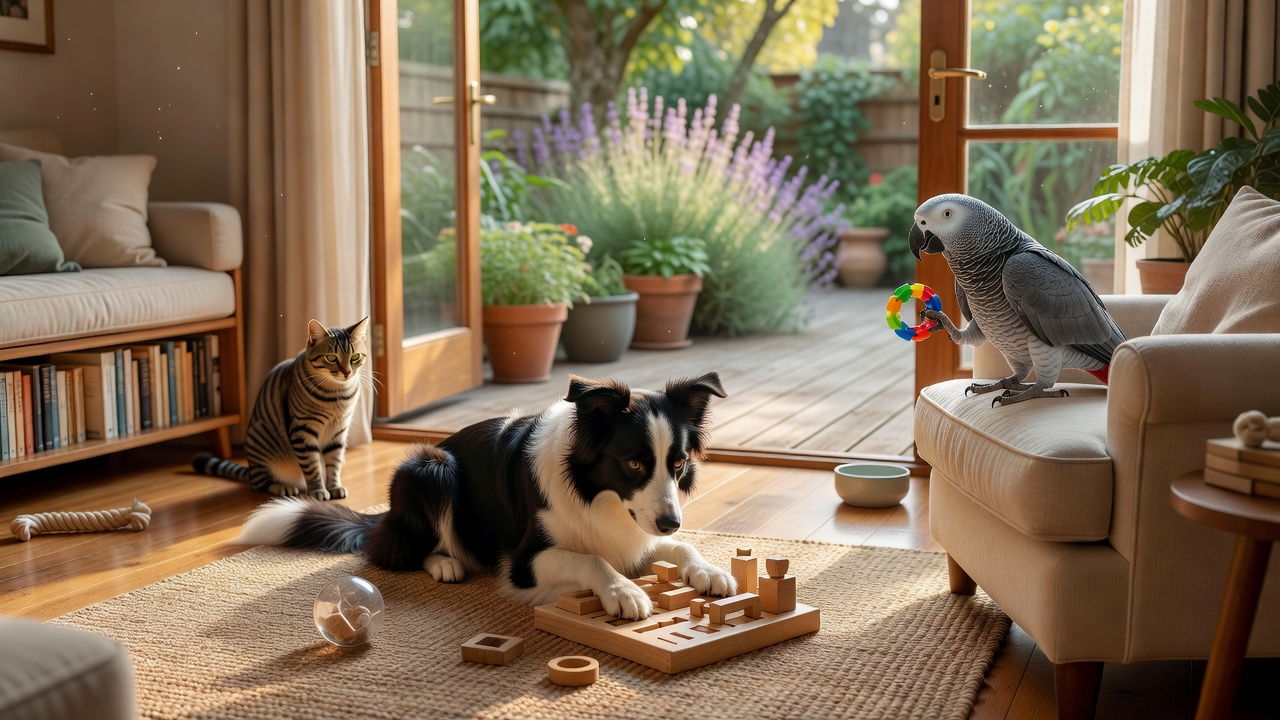
If you share your home with a dog, cat, parrot, or pig, understanding their cognitive needs isn’t just trivia — it changes how you care for them. Smart animals get bored easily, and bored animals develop destructive habits. Puzzle feeders, scent games, and rotating toys aren’t just cute Instagram content; they’re genuine mental exercise that keeps intelligent pets calmer and happier.
Even goldfish, long mocked for their supposed three-second memory, can actually learn to navigate mazes and recognize feeding schedules. No animal is as simple as old myths suggest.
The Bigger Picture
Every time researchers study a new species closely, the definition of “smart” gets a little more complicated — and a little more humbling. The smartest animals aren’t necessarily the ones most like us. They’re the ones that solved survival in ways we’re still working to fully understand, whether that’s an octopus unscrewing a jar or a crow remembering your face for a decade. Respecting that intelligence, in pets and wildlife alike, is part of what makes animal lovers pay closer attention in the first place.