
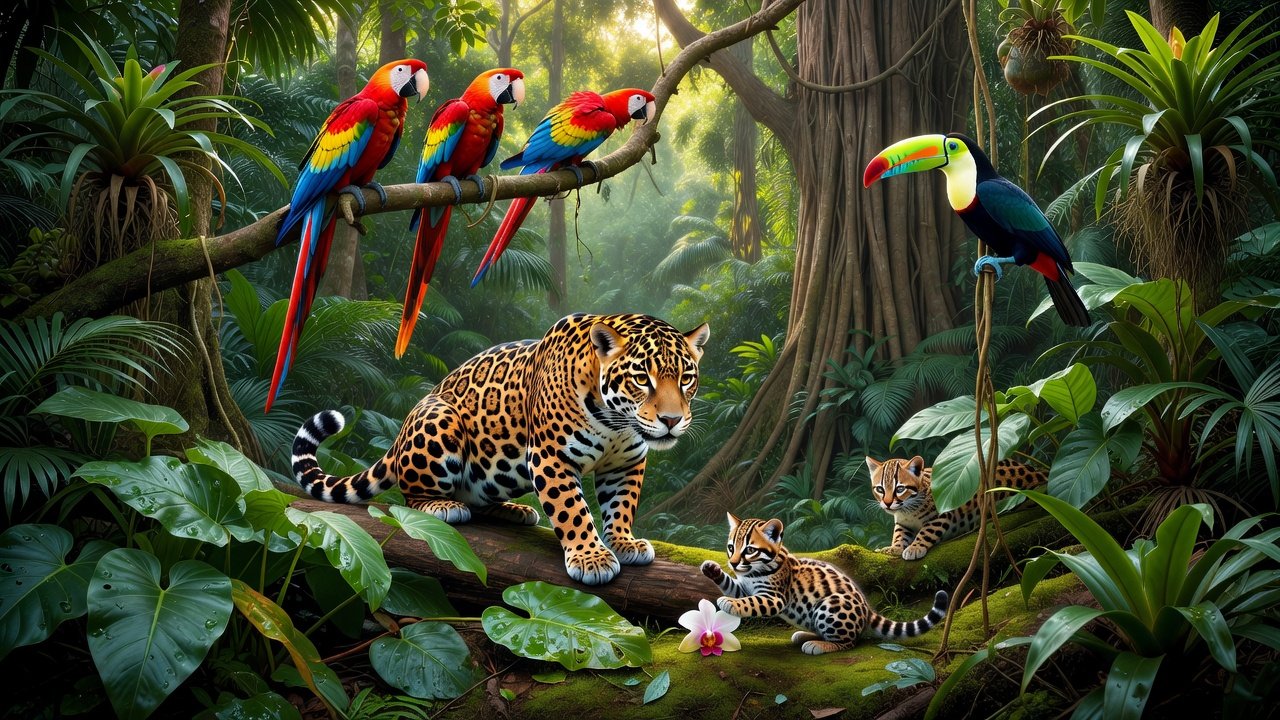
Rainforest Animals: Colorful Creatures of the Jungle
\n
As someone who has spent years observing the quirky personalities of my three rescue cats, I’m continually amazed by how wildlife in the world’s most biodiverse ecosystems mirrors the unique traits we cherish in our companion animals. Rainforest animals, with their vibrant colors, clever adaptations, and complex social behaviors, captivate pet owners and nature enthusiasts alike. These creatures thrive in the layered world of tropical and temperate rainforests—from the steaming Amazon to the misty forests of Southeast Asia and Central Africa.
\n

\n
While my rescue cats find comfort in a safe indoor environment, rainforest species have evolved extraordinary strategies to survive in one of Earth’s most competitive habitats. This guide explores their fascinating lives, conservation challenges, and how we can all play a role in protecting them—without any medical claims, just educational facts grounded in reputable sources.
\n\n
The Layered World of the Rainforest
\n
Rainforests are structured in distinct vertical layers, each supporting specialized animal communities. The emergent layer, with trees reaching 200 feet, is home to eagles and bats. The dense canopy shelters the majority of species, including monkeys, sloths, and countless birds. The understory and forest floor host jaguars, tapirs, and insects. This stratification allows for incredible biodiversity—scientists estimate that over half of the world’s plant and animal species live in rainforests that cover less than 2% of the planet’s surface.
\n\n
Iconic Mammals and Their Adaptations
\n
Jaguars: Powerful Swimmers and Apex Predators
\n
The jaguar (Panthera onca) is the largest cat in the Americas. Unlike many felines, jaguars are excellent swimmers and often hunt along riverbanks, using their incredibly strong bite—estimated at 1,500 psi—to crush turtle shells and caiman skulls. Their rosette-patterned coats provide perfect camouflage in dappled forest light. According to the World Wildlife Fund, habitat loss has made jaguars vulnerable, with populations declining due to deforestation for agriculture and roads that fragment their large territories (they need up to 100 square kilometers per individual in some areas).
\n\n
Sloths: Masters of Energy Conservation
\n
Sloths spend up to 20 hours a day hanging upside down, thanks to specialized tendons and a slow metabolism that allows them to survive on a low-energy diet of leaves. Algae growing in their fur not only gives them a greenish tint for camouflage but also supports a miniature ecosystem of moths and insects. Three-toed and two-toed sloths differ in behavior and diet. The Smithsonian Institution notes that sloths descend to the forest floor only about once a week, making them vulnerable during that time to predators.
\n\n
Spider Monkeys and Harpy Eagles
\n
Spider monkeys use their prehensile tails like a fifth limb to swing through the canopy, playing a key role in seed dispersal. Harpy eagles, with wingspans up to 7 feet and talons the size of grizzly bear claws, are apex avian predators that require vast territories. Both species are threatened by habitat fragmentation.
\n\n
Vibrant Birds and Their Roles
\n
Toucans use their large, lightweight bills to reach fruit on thin branches without breaking them, aiding in seed dispersal. Scarlet macaws, with lifespans over 50 years, mate for life and use their powerful beaks to crack nuts. Their loud calls help maintain flock cohesion across the canopy. National Geographic highlights how parrots and toucans are vital pollinators and seed dispersers, contributing to forest regeneration.
\n\n
Reptiles, Amphibians, and Insects
\n
Poison dart frogs derive their skin toxins from their diet of specific ants and mites (captive-bred frogs lack this toxicity). Their bright colors serve as aposematic (warning) signals. Green anacondas, the heaviest snakes, can exceed 20 feet and give birth to live young. Goliath beetles and bullet ants demonstrate the immense insect diversity—bullet ant stings are among the most painful known to humans but rarely fatal.
\n\n
Conservation Challenges and Success Stories
\n
Deforestation, illegal wildlife trade, and climate change threaten these species. The Amazon alone loses an area the size of a football field every few seconds. However, protected areas and community-led conservation by organizations like WWF and indigenous groups are making a difference. Breeding programs in accredited zoos (accredited by the Association of Zoos and Aquariums – AZA) help maintain genetic diversity for species like the golden lion tamarin and harpy eagle.
\n\n
How Pet Owners Can Help Rainforest Animals
\n
Choose sustainable products certified by the Rainforest Alliance or FSC. Support reputable conservation organizations. Reduce your carbon footprint to combat climate change impacts on rainfall patterns. Visit AZA-accredited zoos that participate in Species Survival Plans. Educate friends and family about the interconnectedness of all animals—wild and domestic. As a rescue cat mom, I see parallels in how compassion for one animal leads to broader advocacy.
\n\n
Sources
\n
Sources
\n
- \n
- World Wildlife Fund (WWF) – Tropical Forests
- National Geographic – Rainforest Animals
- Smithsonian – Rainforest Biodiversity
- Association of Zoos and Aquariums (AZA)
- Rainforest Alliance
\n
\n
\n
\n
\n
\n
\n\n\n
Related Posts
\n
- \n
- Rainforest Animals: 25 Incredible Creatures You Need to Know About
- Ugly Animals: Why These Creatures Are Worth Loving
- Zoo Animals: Complete Guide to the World’s Most Fascinating Creatures
- The Most Weird Animals on Earth: Bizarre Creatures You Won’t Believe Are Real
- Farm Animals: Complete Guide to the Creatures That Feed Our Nation
\n
\n
\n
\n
\n
\n