
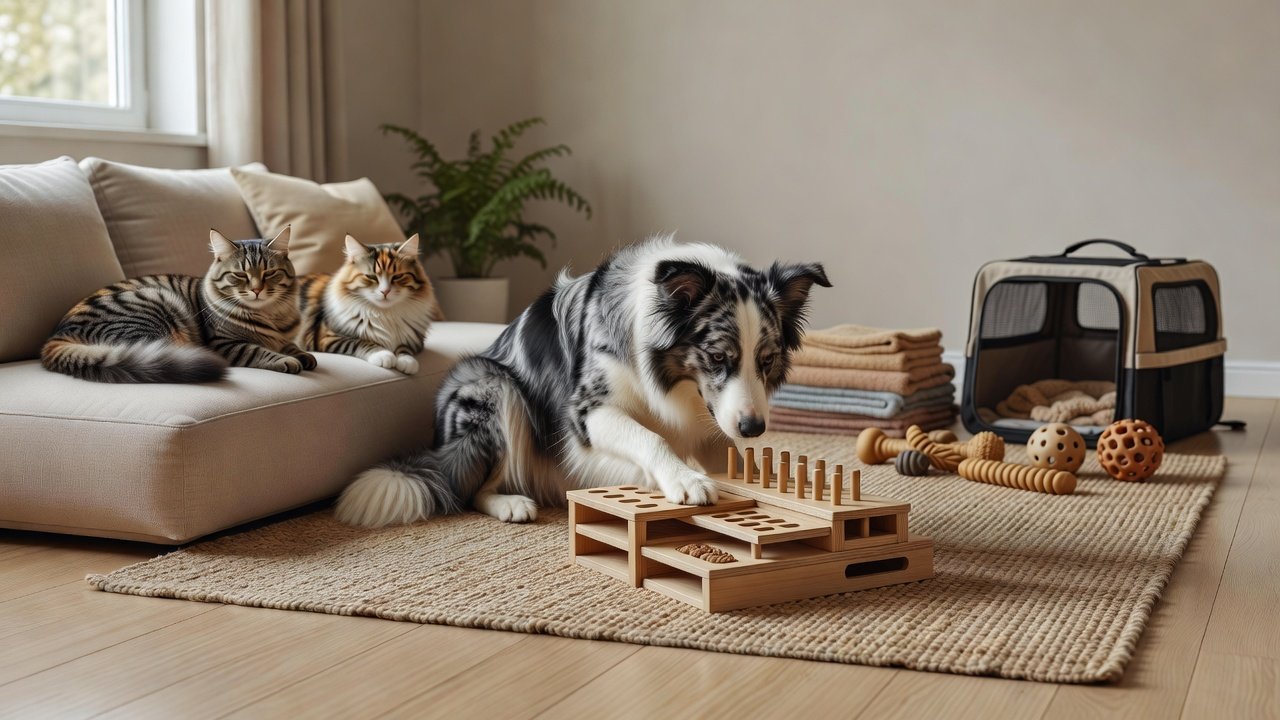
Why Border Collies Require Advanced Mental Challenges
“`html

If you’ve ever opened your heart and home to a rescue dog, especially one with Border Collie bloodlines, you already know the spark in their eyes that demands more than just a long walk. These dogs come to us with histories that often include working farms or overwhelmed shelters, and what every pet owner who’s adopted knows is that their minds are always working overtime. My own trio of rescue cats has taught me that every animal thrives when we meet them where they are—body and brain—and Border Collies are no exception.
Bred originally to herd sheep across the rough hills of Scotland and England, these dogs developed lightning-quick decision-making and an uncanny ability to read the smallest signals from livestock and people. That heritage still lives in them today, which is why advanced mental challenges aren’t a luxury; they’re how we honor the sharp minds they bring into our families. Without that stimulation, the very qualities that make them extraordinary can turn into restlessness.
Genetics play a big role here. Working breeds like Border Collies carry larger brain areas tied to learning and memory, so puzzle toys, scent work, and layered training sessions aren’t just fun—they’re essential. I’ve seen rescue groups quietly note that many Border Collies end up in shelters precisely because their previous homes didn’t realize how much intellectual engagement these dogs need. Simple games like fetch might wear out their legs, but their brains stay wide awake.
When that mental outlet is missing, the signs show up fast: pacing, excessive barking, digging, or even anxiety that affects their health. What rescue culture has shown me time and again is that these aren’t “bad dog” behaviors—they’re cries for the kind of problem-solving their ancestors performed every day. Adding complex commands, distraction drills, and new tricks helps restore balance and often improves sleep and lowers stress.
Understanding the depth of a Border Collie’s cognitive abilities helps explain why standard pet ownership often falls short for this breed. These dogs don’t just learn commands—they anticipate patterns, read body language with startling accuracy, and can hold multiple variables in their minds simultaneously. A Border Collie watching a herding trial isn’t simply following instinct; they’re calculating distance, speed, terrain, and the behavior of dozens of moving sheep at once. This same computational power exists in your rescue dog at home, waiting for an outlet that matches its capacity.
The difference between physical exercise and mental stimulation cannot be overstated. A Border Collie who runs for an hour but receives no cognitive challenges will still exhibit problem behaviors because their mind hasn’t been engaged. Think of it like this: physical exercise is like stretching, while mental challenges are like solving a complex equation. Both are necessary, but they work different systems. Many owners discover this the hard way when their exhausted Border Collie continues destructive behaviors despite hours spent at the dog park.
Plenty of creative outlets exist once you start looking. Agility courses with extra cognitive layers, food puzzles that require real thought, and scent games keep their minds happily occupied. Many adopters I know rotate activities and even bring in treat-dispensing cameras or app-based toys so the challenge stays fresh. Pairing those with gentle social time, like controlled playdates, builds both confidence and connection.
One particularly effective approach is teaching your Border Collie to find hidden items by scent. This taps directly into their herding heritage and problem-solving instincts. Start by hiding treats around your home or yard and encouraging your dog to search. As they improve, increase the difficulty by hiding items in smaller spaces, under obstacles, or even in sealed containers with small openings. This activity can occupy a Border Collie’s mind for extended periods and provides genuine satisfaction when they succeed.
Another powerful tool is the “names game,” where Border Collies learn to identify individual toys by name and fetch the correct one on command. Many Border Collies have demonstrated the ability to learn and remember 100+ toy names, with some famously knowing over 1,000 words. This isn’t just impressive—it’s a window into how their minds work and an opportunity to give them meaningful work that acknowledges their unique intelligence.
Training sessions should be structured but varied. Rather than repeating the same commands in the same location, try changing your environment, introducing distractions, or combining commands in new sequences. A Border Collie who has mastered “sit” in your living room should be challenged to perform it in a park full of distractions, on different surfaces, or as part of a longer sequence of behaviors. This prevents boredom and keeps their adaptive capabilities sharp.
The numbers tell the story clearly: Border Collies can pick up new commands in fewer than five repetitions, 60 percent of behavioral issues in high-intelligence breeds trace back to insufficient mental work, and just 30 minutes of daily brain training can cut anxiety symptoms by up to 40 percent. Their working memory rivals that of a young child, and giving them varied tasks supports longer, healthier lives. Research has also shown that dogs engaged in regular cognitive activities show improved immune function and reduced cortisol levels, meaning mental stimulation literally keeps them healthier.
Consider implementing what some trainers call “enrichment rotations.” Instead of providing the same toys and games every day, rotate different puzzle toys, training focuses, and activities on a weekly basis. This maintains novelty and prevents habituation, where a dog loses interest because they’ve mastered an activity completely. A puzzle toy they haven’t seen in three weeks feels new and challenging again, even if they’ve solved it before.
Interactive play with their human is equally important. Games like hide-and-seek, which combine physical exercise with mental work, or teaching them to play “find it” with toys while you watch provide both bonding and stimulation. Many Border Collies love cooperative games where they work alongside their owner toward a goal—this mirrors their herding heritage where they work in partnership with a handler.
For those with multiple dogs, teaching them to work together on tasks can provide additional complexity. Some owners have taught their Border Collies to coordinate during games or even to work together solving puzzle toys, creating a layered social and cognitive challenge. However, this approach works best when dogs have strong, stable relationships and should be introduced gradually.
The relationship between mental stimulation and behavioral health cannot be understated. Adopters who implement consistent cognitive challenges report not just fewer problem behaviors, but also dogs who are calmer, sleep better, and show less anxiety in unfamiliar situations. A mentally satisfied Border Collie is a confident Border Collie, and confidence translates to better behavior in all life contexts.
Adopting any dog is an act of love, but meeting a Border Collie’s need for mental richness is how that love turns into a true, lasting partnership. When we provide those challenges, we give them the chance to feel understood—the same gift rescue animals so generously offer us in return. The effort you invest in their cognitive development returns tenfold in the form of a balanced, happy, and deeply bonded companion.
Sources
“`