
Rainforest Animals: 25 Incredible Creatures You Need to Know About
“`html
Rainforests might cover less than 2% of our planet, but they shelter more than half of the world’s animal species, creatures whose lives remind me so much of the quiet resilience I see every day in my own rescue cats. These lush worlds, from sun-drenched canopy to shadowed forest floor, hold animals found nowhere else—each one carrying a story of adaptation and survival that echoes the bond we form when we open our homes to pets in need.
What every pet owner who’s adopted knows is that the smallest gestures of care can change everything. Whether you’re drawn to wildlife or simply love sharing your life with animals, the creatures of the rainforest invite us to look closer at why protecting wild spaces matters just as much as supporting local shelters.
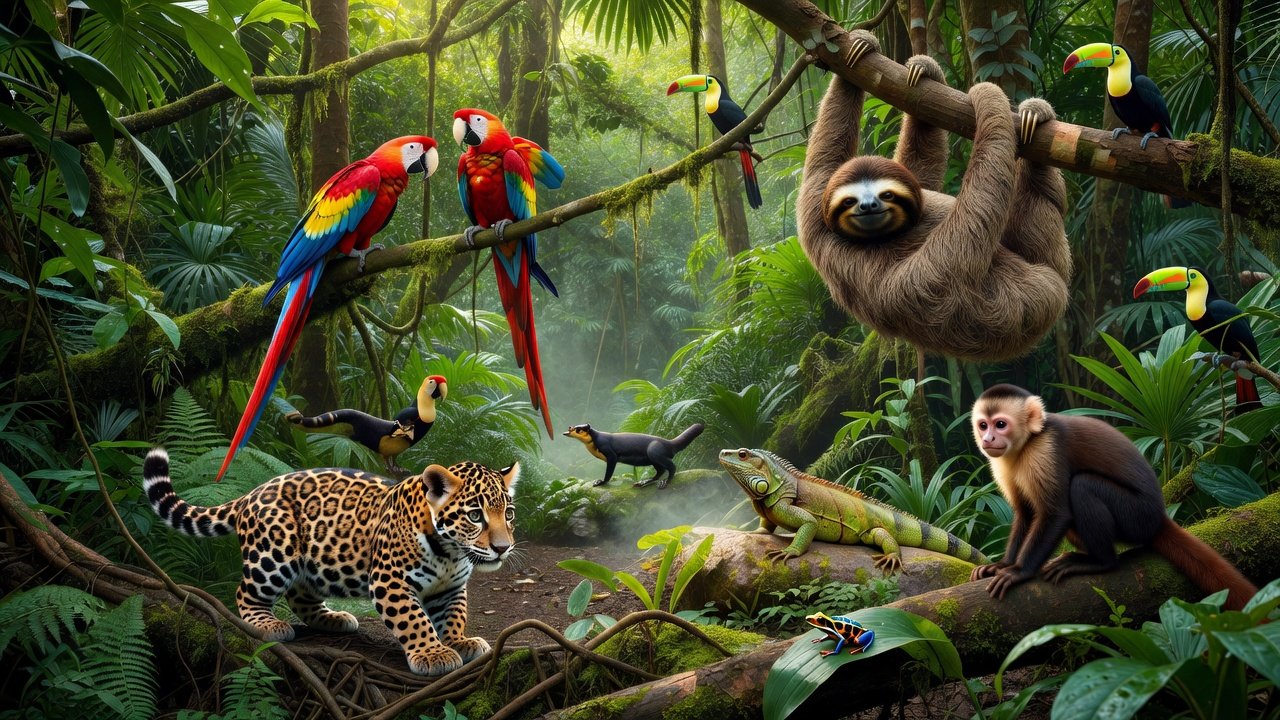
My rescue cats have taught me that even the quietest souls can become fierce protectors of their little world. In the same way, jaguars rule as the Americas’ largest cats and apex predators of South American rainforests. Weighing up to 250 pounds, these powerful swimmers with their spotted coats face grave danger from habitat loss—endangered now, yet still vital to the balance of their home. Unlike their feline cousins in Africa, jaguars are excellent swimmers and often hunt in water, taking caimans and capybaras as prey. Their solitary nature means they require vast territories to survive, making habitat fragmentation one of their greatest threats.
Then there are the sloths, those famously slow canopy dwellers who spend up to 20 hours resting while algae grows on their fur for camouflage. Three-toed or two-toed, they embody the kind of peaceful presence that makes you slow down and simply be. I often think of them when one of my cats stretches out in a sunbeam, content in a way only rescued animals seem to appreciate fully. Sloths move so deliberately that they only descend to the forest floor once a week to defecate, and their slow metabolism allows them to digest their low-nutrition leaf diet efficiently. Their arms are proportionally longer than their legs, perfectly adapted for their upside-down existence in the canopy.
The green anaconda, the world’s heaviest snake, can stretch beyond 20 feet and spends much of its life in water. Non-aggressive unless threatened, it plays its quiet role in the ecosystem—much like the understated contributions rescue pets make once they feel safe. These snakes are ovoviviparous, meaning they give birth to live young rather than laying eggs, with a single female producing between 20 to 40 babies. Their heat-sensing pits allow them to detect warm-blooded prey in complete darkness, making them formidable hunters despite their docile reputation.
Color explodes across the rainforest, just as personality blooms in every adopted animal. Poison dart frogs, no bigger than a thumbnail, carry enough toxin to endanger humans, their bright hues a warning that says “look but don’t touch.” Indigenous peoples once used those same toxins on darts, a reminder of how deeply intertwined humans and animals have always been. What’s fascinating is that these frogs likely derive their toxins from their diet of certain insects, and frogs raised in captivity without access to these specific insects never develop their signature poison—a testament to how interconnected rainforest species truly are.
Macaws flash brilliant blues, reds, and yellows, living over 50 years, calling loudly, and mating for life. Their intelligence and loyalty stir the same warmth I feel watching my cats recognize one another after years together. These large parrots can remember individual humans and have been observed using tools in the wild. Their curved beaks are powerful enough to crack hard nuts that other animals cannot access, and their role in seed dispersal is crucial to maintaining rainforest diversity. Some macaw species have wingspans exceeding three feet, making them among the longest flying birds in the rainforest.
The rainbow boa adds its own shimmer, scales refracting light into living rainbows while it hunts small prey through the undergrowth. This iridescent effect comes from microscopic ridges on their scales rather than pigmentation, creating a display that changes with the angle of light. They’re semi-aquatic constrictors that prefer humid environments and are known for their defensive behavior of musking when threatened.
Up in the canopy, spider monkeys swing with acrobatic grace using prehensile tails, spreading seeds that keep the forest alive. These primates are primarily frugivores and play an essential role in seed dispersal across vast territories. They live in fission-fusion societies where groups split and rejoin throughout the day, and their complex communication involves over 25 different vocalizations. Harpy eagles, talons like grizzly claws, hunt from above yet stand endangered from lost habitat. These massive raptors can weigh up to 20 pounds and have wingspans approaching seven feet, making them among the largest and most powerful eagles in the world. A single harpy eagle pair requires an enormous territory to hunt successfully.
Countless tree frogs, including red-eyed and glass varieties, lay eggs in bromeliads and signal the health of the whole system with their presence. Glass frogs possess translucent bellies that reveal their eggs and internal organs, an adaptation that helps them camouflage against backlit leaves. Red-eyed tree frogs, with their striking crimson eyes and adhesive toe pads, are icons of rainforest biodiversity and indicate thriving ecosystems with intact canopy structures.
On the forest floor, jaguarundis prowl by day with bird-like chirps, capybaras—the world’s largest rodents—weigh in at 140 pounds and gather peacefully near water, and tapirs with their curious snouts engineer trails while dispersing seeds. These ground-dwellers thrive in humidity and shadow, much like the steady comfort a rescued pet brings to a quiet home. Tapirs are actually more closely related to horses and rhinoceroses than to the rodents they live alongside, and their prehensile upper lips help them select specific plants. Capybaras are highly social and can form groups of up to 100 individuals, communicating through barks, whistles, and tooth chattering.
Insects and arachnids dominate by number. Bullet ants deliver a sting likened to a gunshot, goliath beetles reach four inches and three ounces, and tarantulas with ten-inch leg spans live peacefully for over 15 years when left undisturbed. Each plays its essential part. Bullet ant venom contains poneratoxin, one of the most potent insect venoms known, yet deaths in humans are rare. Goliath beetles are among the heaviest insects on Earth and can be found on the forest floor and in burrows. Rainforest tarantulas are generally docile compared to their reputation and play important roles in controlling insect populations.
Rivers pulse with pink river dolphins using echolocation through flooded forests, caimans ranging from dwarf to spectacled sizes, and electric eels generating charges to navigate and hunt. These aquatic lives depend on clean waterways, just as our companion animals depend on responsible care. Pink river dolphins, also called botos, have unfused neck vertebrae allowing them to turn their heads nearly 90 degrees, and they’re known for their intelligence and playful behavior. Electric eels can generate discharges of up to 600 volts, which they use not just for hunting but also for communication and navigation through murky waters.
The rainforest is also home to countless species we haven’t even discovered yet. Scientists estimate that millions of species remain undescribed, and new animals are identified in rainforests every year. This unknown wealth of life underscores the urgency of conservation efforts.
Rainforests produce 20% of the world’s oxygen, their animals serving as living indicators of planetary health. When species vanish, larger problems follow. Supporting conservation groups, choosing sustainable products, lowering our carbon impact, sharing knowledge, and uplifting indigenous communities who steward these lands are all ways we extend the same compassion that drives pet adoption. Indigenous peoples have lived sustainably in rainforests for thousands of years, and their knowledge of medicinal plants and sustainable harvesting practices is invaluable.
From jaguar to dart frog, each rainforest animal tells a tale of connection and endurance. They deserve our protection, the way every shelter animal deserves a chance at the kind of love my three rescue cats have given me in return.
Sources
- Rainforest Animals: Colorful Creatures of the Jungle
- Sea Animals: 25 Incredible Creatures of the Ocean You Need to Know
- Ugly Animals: Why These Creatures Are Worth Loving
- Zoo Animals: Complete Guide to the World’s Most Fascinating Creatures
- The Most Weird Animals on Earth: Bizarre Creatures You Won’t Believe Are Real