
Building Protective Loyalty in Your Rottweiler Through Positive Training
“`html

Rottweilers carry a well-documented guarding and herding heritage that predisposes them to strong family attachment and situational vigilance. From a clinical standpoint, channeling this into reliable protective loyalty requires structured positive reinforcement rather than suppression, as the latter can amplify underlying stress responses in the limbic system.
In my years as a vet tech, I’ve seen this situation countless times where owners misread normal alert postures as aggression when the dog is simply orienting to novel stimuli. Recognizing normal alert behaviors means noting calm positioning between the handler and an approaching stranger, measured barking at environmental changes, or sustained visual monitoring of visitors. These responses reflect breed-typical loyalty; responding with a steady redirect teaches the dog that the handler controls threshold assessment.
What owners often miss here is distinguishing loyalty from fear-based reactivity. Growling or lunging without identifiable triggers frequently signals anxiety rather than protective intent. Early, systematic socialization paired with counter-conditioning protocols converts these into confident, controlled outputs that align with true protective function.
Understanding the neurobiological foundations of protective behavior helps contextualize why Rottweilers naturally excel at guarding roles. Their limbic system—the emotional processing center—is highly attuned to environmental threats, but without proper conditioning, this sensitivity can manifest as defensive aggression rather than controlled vigilance. Positive reinforcement training essentially rewires the neural pathways associated with alertness, teaching the brain to defer to handler judgment rather than triggering autonomous fight-or-flight responses. This is why punishment-based approaches frequently backfire; they reinforce the emotional arousal that drives inappropriate protective displays rather than replacing it with calm, handler-directed decision-making.
The development of protective loyalty also depends on establishing a secure attachment foundation during critical developmental windows. Puppies exposed to diverse environmental stimuli—varied surfaces, sounds, vehicles, and people—between three and sixteen weeks of age develop greater confidence and lower baseline anxiety. This early socialization doesn’t mean forcing puppies into overwhelming situations but rather gradually introducing manageable novelty with positive associations. A well-socialized Rottweiler puppy encountering a delivery person learns that strangers can predict good things (treats, praise) rather than defaulting to wariness.
Protective loyalty strengthens most reliably when daily interactions reinforce secure attachment. Short, high-value play sessions using preferred toys, followed by deliberate termination on a success cue, build positive associations. Evening massage routines lower baseline cortisol and promote parasympathetic relaxation, while structured loose-leash walks allow controlled exploration without reinforcing independent scanning.
The role of consistency in leadership cannot be overstated when working with protective breeds. Rottweilers are highly perceptive animals that quickly calibrate their responses based on handler behavior patterns. A handler who sometimes reacts anxiously to perceived threats inadvertently signals that the dog should also be anxious, which escalates protective responses. Conversely, a calm, decisive handler who consistently manages environmental interactions teaches the dog that protective vigilance, while appreciated, isn’t necessary for safety—the handler has control. This confidence-building approach creates dogs that are reliably protective without being hypervigilant or reactive.
Rottweilers respond to consistent, low-arousal leadership. Establishing and maintaining simple household rules—such as doorway protocols or meal routines—provides the predictability that allows the dog to defer to handler direction instead of defaulting to independent action. When a Rottweiler knows that guests enter only after a specific cue and that mealtimes follow a consistent pattern, the dog’s protective drive becomes channeled into these predictable frameworks rather than manifesting as unpredictable alertness.
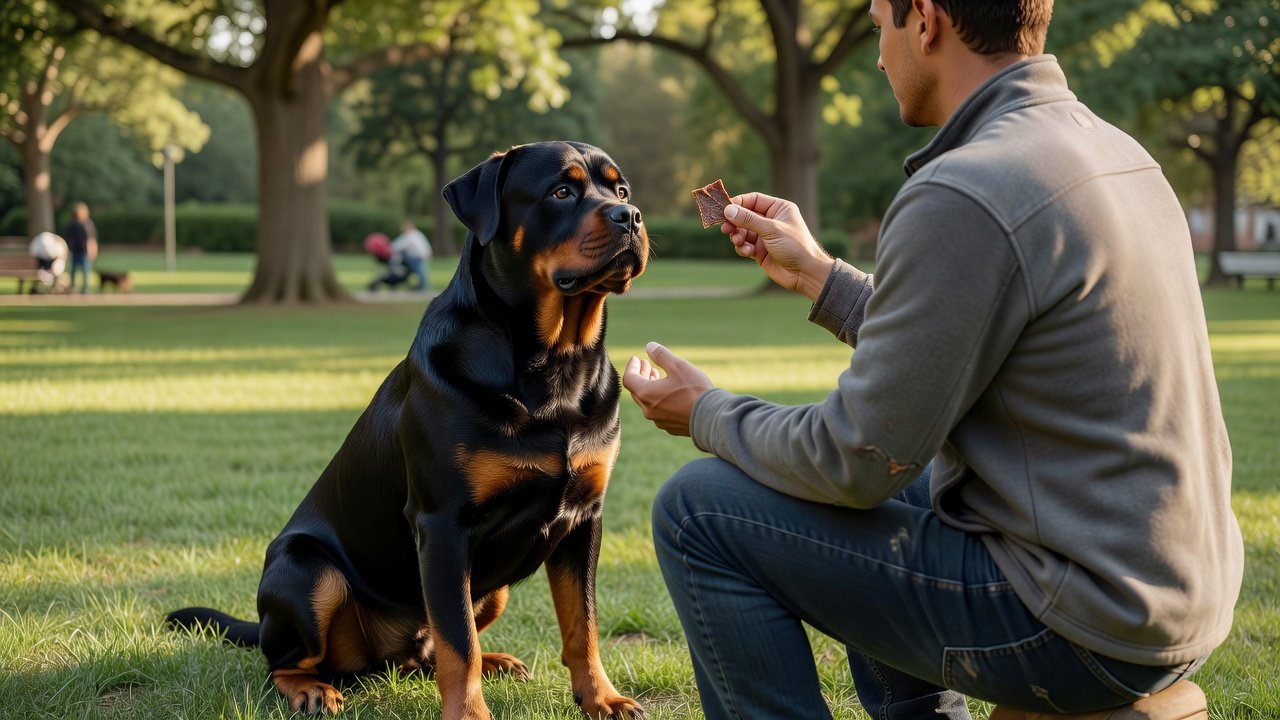
Modern training methodology relies on operant conditioning through positive reinforcement. Teaching the “watch” cue begins in low-distraction environments: when the dog orients toward an approaching person, the handler delivers the cue and immediately reinforces eye contact with high-value treats. Over repeated trials, this creates a check-in habit that interrupts autonomous decision-making. The dog learns that noticing something novel is appropriate, but the next step is confirming with the handler rather than responding independently.
The “place” command similarly redirects protective drive into a predictable station, such as a mat adjacent to entry points. Reinforcement for remaining in position converts instinctive alertness into a structured, handler-controlled behavior. Many professional protection dog trainers use this technique because it allows the dog to maintain environmental awareness—fulfilling the protective instinct—while preventing inappropriate responses. A Rottweiler stationed on a mat near the door can still alert to arrivals through body tension or a single bark, but the physical boundary and learned cue system prevent escalation.
Supporting commands include “quiet” for terminating vocalization once the handler has evaluated the stimulus, “leave it” to inhibit engagement with potential triggers until cleared, “come” for immediate recall, and “settle” for post-alert relaxation on a designated bed. Each is trained separately using graduated criteria and variable reinforcement schedules to promote reliability. The “quiet” cue is particularly important and often misunderstood; it doesn’t teach the dog never to bark but rather to cease barking upon command. This preserves the protective function while giving the handler control over duration and intensity.
Building these command structures requires patience and systematic progression. Begin each command in a controlled environment with minimal distractions, gradually increasing environmental complexity as the dog demonstrates reliable performance. Many handlers rush this process, introducing commands in high-arousal situations before the dog has internalized the behavior at a lower threshold. This is why brief, frequent training sessions—ten to fifteen minutes per day—typically yield better results than longer, infrequent sessions with a tired or frustrated dog.
Variable reinforcement schedules deserve specific attention because they’re frequently implemented incorrectly. Once a dog demonstrates reliable response to a command, gradually shifting from continuous reinforcement (reward every time) to intermittent reinforcement (reward unpredictably) dramatically increases the durability of the behavior. This means sometimes rewarding the fifth “watch” cue or the third “place” command, keeping the dog engaged because the outcome remains slightly unpredictable. However, this shift should only occur after the dog has demonstrated consistent, reliable performance with continuous reinforcement.
Common pitfalls include applying punishment to alert barking, which risks creating conflict between the dog’s innate role and handler expectations. Redirecting to an incompatible behavior and reinforcing the desired response avoids this. Encouraging overt displays of aggression during training sessions can inadvertently strengthen unchecked reactivity; focus instead on controlled orientation followed by release cues. Session length should remain brief to maintain engagement and prevent frustration-induced errors.
A frequently overlooked aspect of protective loyalty training involves teaching the dog appropriate threshold management. Some situations genuinely warrant heightened alertness or vocalization, while others don’t. Teaching a Rottweiler to distinguish between routine household sounds and genuine anomalies requires exposure and conditioning. Sound recordings of doorbells, knocking, and common household noises paired with positive associations help the dog learn context-dependent responses rather than reacting identically to all stimuli.
The handler’s emotional state during training also influences outcomes more than many owners realize. Dogs perceive and mirror human anxiety through pheromone detection and subtle body language cues. A handler who becomes tense during “watch” or “place” training inadvertently communicates that the situation warrants concern, which can amplify the dog’s protective arousal. Maintaining a calm, matter-of-fact demeanor during training teaches the dog that alertness is appropriate but urgency isn’t necessary.
With consistent application of these principles, the Rottweiler develops into a balanced protector whose loyalty is expressed through handler-directed responses rather than autonomous action. This represents the ideal protective dog—one that possesses the genetic predispositions and instincts for protection but has learned to channel them through handler guidance. The result is a reliable, trustworthy family member whose protective nature enhances rather than complicates household dynamics.
Sources
- American Kennel Club (AKC) – Official Rottweiler Breed Information and Standards
- ASPCA – General Dog Care and Training Guidelines
-
Related Posts
- German Shepherd Training Tips for Positive Behavior
- Training Tricks to Improve Recall in Off-Leash Dogs
- Facts on the Loyalty Traits of German Shepherds
- Training Your Dog to Walk Calmly Leash
- Tips for Litter Training Rescue Cats Effectively